Skip to content

How our biggest product failed

Jan 19, 2026 5 min reading time

TL;DR - Our first product failed. We went all in, developed it for months, asked friends to test it, created a website, and developed and launched a full marketing campaign. We sold nothing. We felt defeated. For our second attempt, we barely tried and created our most successful product yet.

Our first product

After 8 months of being digital nomads, we found we had something to share with other nomads and avid travellers through a comprehensive Travel Hub Notion template.

We poured months of effort and countless hours into its development, believing we were creating something revolutionary. It was a one-stop platform that would transform how people plan and experience their travels.

We improved it, revised it, gathered feedback from friends, tweaked it again, developed marketing collateral, and were excited to get it out into the world for others to use.

Loading image: Travel Hub is a comprehensive all-in-one Notion template that lets you plan all your trips in one place, collaborate with others, track expenses and itineraries, analyze travel statistics, create packing lists, add travel documents, and review country information for quick planning. Travel Hub is a comprehensive all-in-one Notion template that lets you plan all your trips in one place, collaborate with others, track expenses and itineraries, analyze travel statistics, create packing lists, add travel documents, and review country information for quick planning.

The launch that didn’t travel far.

We prepared loads of marketing collateral. Newsletters, instagram posts, reels, stories, website images, video tutorials, and PDF guidebooks. Each one had multiple drafts. Literally hundreds of hours poured into it all. We whole-heartedly believed we were ready.

Come the big day, we had high hopes things would go well and the product would be a hit. Well… minutes went by, hours went by, days went by, weeks went by. Not a single product was sold. Ouch.

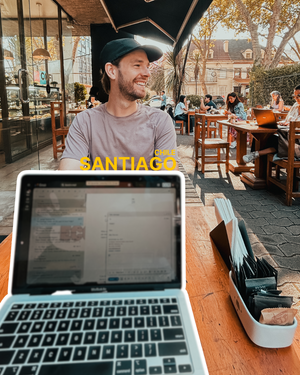
Loading image: Remote work from café in Santiago, Chile with coffee and laptop Remote work from café in Santiago, Chile with coffee and laptop

If someone tells you your product is worth less, it doesn’t mean it’s worthless.

Before we launched, we sent the product around to friends who travelled often to see how they valued the tool. We wanted to gauge how valuable they all thought the tool was in order to inform our pricing strategy.

Almost all our reviewers valued our product far below what we thought it was worth. Reality set in that we had spent months developing a dud. It was a tough pill to swallow but inspired one of the biggest learnings of our business so far… the value perception gap.

If it were not for the perspective of 1 reviewer who saw the real potential of our product, and actually suggested that the product was undervalued, we would have likely believed the majority of our friends and underpriced our product.

It showed us that in order to convince someone there is value in something, you have to shown them the value. You cannot rely on them finding the value for themselves. We had failed on this front.

We learned that building a great product is only half the battle. The other half - and perhaps the more crucial one - is effectively communicating its value to potential customers. We had focused so intently on creating great features and functionalities that we had neglected to craft a compelling narrative about why the Travel Hub was going to solve every problem our target audience had with travel.

We had assumed that the value of the Travel Hub would be self-evident, but in reality, we needed to work harder to articulate its benefits and unique selling points.

Loading image: Easy-to-use and comprehensive profit and loss tracker template on Notion for freelancers, small businesses, and side-hustles. Organize all your businesses finances in one centralized place. Monitor profitability across your business by project and by client. Easy-to-use and comprehensive profit and loss tracker template on Notion for freelancers, small businesses, and side-hustles. Organize all your businesses finances in one centralized place. Monitor profitability across your business by project and by client.

Our underdog.

Interestingly, our experience with the Travel Hub stands in stark contrast to another product we launched. If the Travel Hub is our Goliath, a tool we poured our blood, sweat, and tears into. Then our P&L Tracker Notion template is our David, a tool we created on a whim, that selfishly helped us as entrepreneurs track our businesses income and expenses.

To our surprise, our P&L Tracker has become our most successful product, generating a substantial portion of our revenue. This unexpected outcome taught us a valuable lesson about market needs and product-market fit.

What the P&L Tracker taught us.

  1. You can't force market acceptance: No matter how much you believe in your product, you can't make the market embrace it. The market decides what it needs and values.
  2. Focus on solving real problems: Our successful product addressed a genuine need for us and that translated to a need in the market. It's crucial to create solutions to real, pressing problems rather than perceived ones.
  3. Effective communication is key: It's not enough to build a great product; you must also effectively communicate its value. Your customers need to understand why your product is essential for them.
  4. Don't underestimate the small projects: Sometimes, the most successful ideas come from addressing immediate, practical needs rather than grand visions.

Moving forward…

Our experience with the Travel Hub, while disappointing in some respects, was invaluable in shaping our approach to developing future products and marketing efforts. We've learned to balance our time for developing products with crafting a compelling narrative for selling the product.

We've definitely learned to embrace failure not as an outcome, but as an essential part of the entrepreneurial journey. And for some odd reason, we're excited to fail again.

Related blog posts.

How we stopped time

Our perception of time stretches when life is full of new experiences instead of routine. Our travels have shown us that we can speed up or slow down time at will without a time machine.

Our travel credit card roster

We break down the 3 types of credit cards you need for travel; one for spending, one for insurance, and one for points. If you can find one that does 2 of these things, you're golden.

Our digital nomad tech kit

2+ years of trial and error to find the digital nomad tech kit that actually works for us. All you need is a good laptop, a good backpack, minimalist accessories, and good connectivity plans.
Back to top